What types of titanium flanges are there?
1.Integral Flange: These flanges are mainly used for the flanges at the inlet and outlet of mechanical equipment such as pumps and valves, and are specially used to connect with the flanges on pipes. These inlet and outlet flanges are usually made integrally with the casing of the mechanical equipment as part of the equipment. The flange is usually cast together with the casing of the equipment, and a few are cast (such as the end flange on a forged steel valve) .
2.Threaded Flange: The inner hole of this type of flange is processed into pipe threads and cooperates with the threaded pipe to achieve connection. It is a non-welded flange. Compared with welded flanges, threaded flanges are easier to install and maintain, and can be used on some pipelines where welding is not allowed on site. Threaded flanges can also be used. However, when the temperature of the pipeline changes rapidly or the temperature is higher than 260°C or lower than -45°C, it is recommended not to use threaded flanges to avoid leakage .
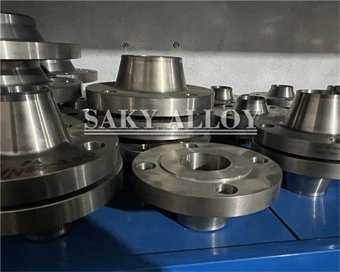
3.Weld Neck Flange: This type of flange is intended to be butt welded to a piping system. Due to its long neck, it is rather pricey but preferred for high-stress applications .
4.Butt Welding Flange: This type of flange has a long and inclined high neck from the welding point of the flange and pipe to the flange plate. The wall thickness of this high neck is along the height direction. The gradual transition into the pipe wall thickness improves stress discontinuities and therefore increases flange strength. Butt welding flanges are mainly used in harsh working conditions, such as pipelines with large fluctuations in pressure and temperature or pipelines used under high temperature, high pressure, and low temperature conditions .
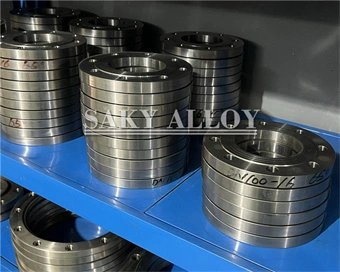
5.Flat Welding Titanium Flange: This type of flange is also known as a lap welding flange. The connection between the flat welding flange and the pipe is to insert the pipe into the inner hole of the flange to the appropriate position first, and then weld it. Its advantage is that it is easier to center during welding assembly and it is cheap, so it has been widely used.